Corporate Tax Rate Canada 2026: Alberta, BC, Manitoba & Ontario
If you run a business in Canada, tax rates are probably taking up way more space in your head than you’d like. Between federal rules and provincial quirks, trying to calculate what you actually owe can feel like solving a puzzle where someone swapped half the pieces. Let’s strip away the corporate speak and look at what you’re actually paying in 2026 across Alberta, British Columbia, Manitoba, and Ontario.
Alberta Small Business Tax Rate 2026 (Combined Federal + Provincial)
Alberta loves reminding everyone that it’s the most business-friendly spot in the country, and honestly, the numbers back up the hype. On the federal side, the net small business tax rate sits at 9% after the federal tax abatement and small business deduction kick in. Alberta charges a provincial small business rate of just 2%.
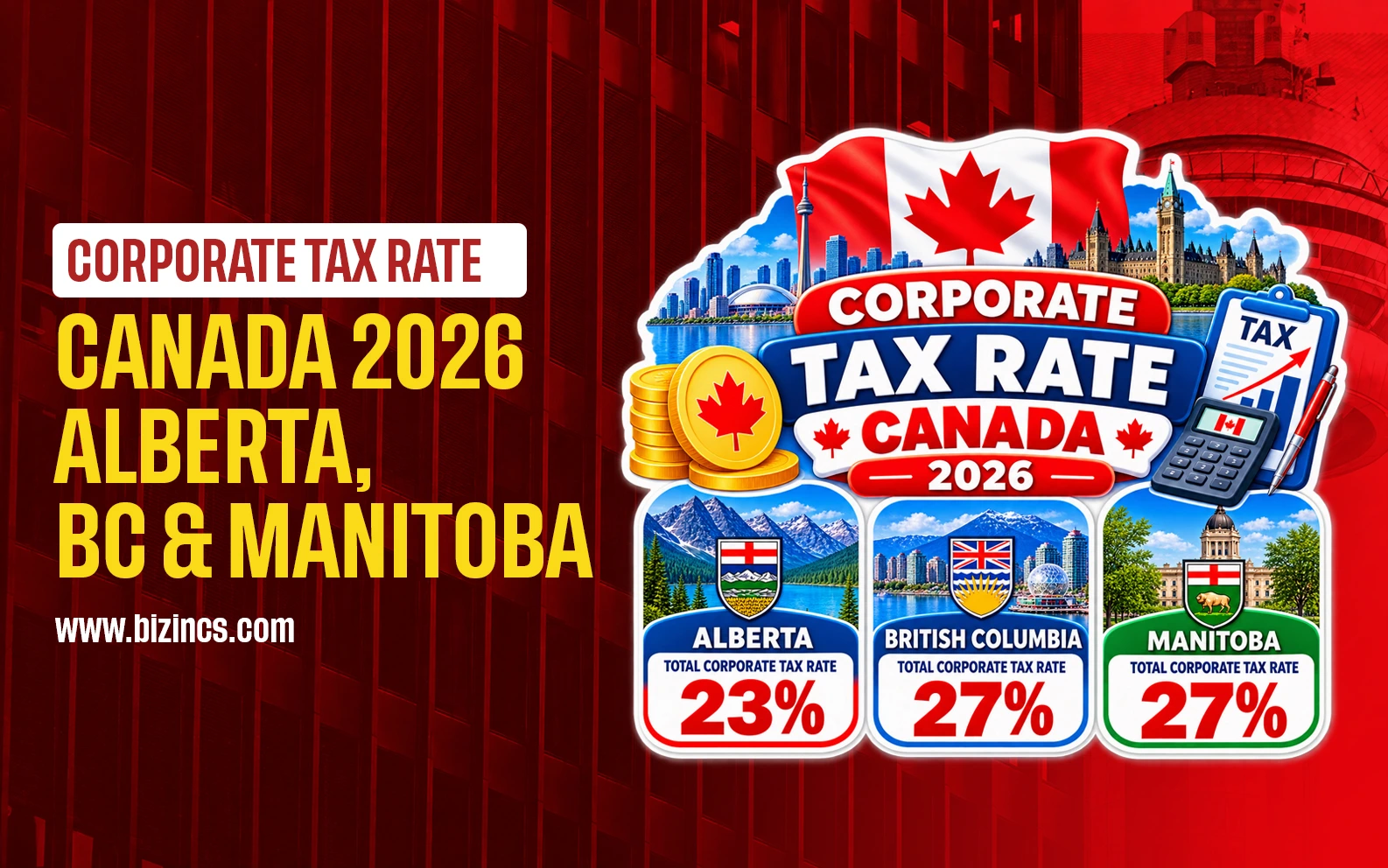
When you stack them together, your combined small business tax rate in Alberta is 11%. That means on your first $500,000 of active business income, the government is taking $11,000 for every $100,000 you earn. Compare that to the general corporate tax rate in Alberta, which sits at a combined 23% (15% federal + 8% provincial), and you can see why staying under that small business threshold is such a big deal.
BC Small Business Tax Rate 2026
Heading west over the Rockies changes things a bit. The tax in BC isn’t terrible, but it will pinch slightly more than Alberta’s setup. British Columbia sets its provincial small business tax rate at 2.5%.
Add that to the standard 9% federal rate, and the combined BC small business tax rate lands at 11.5%. Is half a percentage point going to break your company? Probably not when you’re starting out. But if you’re pulling in $400,000 in net profit, that half-percent means an extra $2,000 out of your pocket every single year. For general corporate income above the small business limit, BC stacks an 12% provincial rate on top of the 15% net federal rate, bringing the general corporate tax rate to 27%.
Manitoba Small Business Tax Rate 2026
Manitoba does something fantastic for small operators, but there’s a huge catch you need to watch out for. On paper, the Manitoba small business tax rate is 0%. You read that right—zero provincial corporate tax on active small business income.
Combine that with the 9% federal portion, and your combined rate is just 9%. It sounds like a dream until you look at the provincial income threshold. Manitoba caps this 0% rate at $500,000 of active business income, but if you cross into general corporate income territory, the provincial rate jumps to 12% (giving you a combined rate of 27%). Also, watch your taxable capital—if your business grows too large, Manitoba scales back your eligibility pretty fast.
Side-by-Side Comparison: AB vs. BC vs. MB vs. Ontario
To see how Ontario fits into the mix alongside the Western provinces, it helps to look at the numbers side by side. Ontario charges a 2.2% provincial small business rate, which brings its combined rate to 11.2%.
- Alberta: 2% Provincial | 11% Combined Small Business Rate | 23% General Rate
- British Columbia: 2.5% Provincial | 11.5% Combined Small Business Rate | 27% General Rate
- Manitoba: 0% Provincial | 9% Combined Small Business Rate | 27% General Rate
- Ontario: 3.2% Provincial | 12.2% Combined Small Business Rate | 26.5% General Rate
Which Province Gives Small Businesses the Best Tax Deal Right Now?
If you’re making under $500,000 in pure profit, Manitoba wins on pure paper math because of that sweet 0% provincial rate. You’re only paying the 9% federal tax.
However, if your business is scaling quickly, Alberta takes the crown. Why? Because once you grow past the small business limit, Alberta’s general corporate tax rate of 23% blows the other provinces out of the water. BC, Manitoba, and Ontario all hit you with combined general rates around 26.5% to 27%. If you plan on building a heavy-hitting corporation, Alberta is usually the cheapest long-term home.
How the Small Business Deduction Threshold Works in Each Province
The Small Business Deduction (SBD) is the mechanism that lets you pay those lower rates instead of the painful general corporate tax rates. Nationally, the federal government sets the active business income limit at $500,000.
Alberta, BC, Manitoba, and Ontario all match this $500,000 threshold for their provincial small business rates. But remember: this isn’t revenue. This is profit (active business income). If your business takes in $1.2 million in revenue but has $800,000 in eligible operating expenses, your active business income is $400,000. You still fit neatly inside the small business tax bracket.
Just keep an eye on passive income. If your corporation earns more than $50,000 in investment income (like dividends, capital gains, or rental profits), the government starts chipping away at your $500,000 small business limit. Once passive income hits $150,000, your small business deduction disappears entirely.
Personal vs. Corporate Tax Rates — Don’t Confuse These
A super common mistake first-time founders make is assuming that corporate profits are instantly their personal money. They aren’t. Your corporation is an entirely separate legal person in the eyes of the CRA.
When your company earns income, it pays the lower corporate tax rates we talked about above (like 11% in Alberta or 12.2% in Ontario). But that money stays inside the corporate bank account. The second you pull that cash out to pay your personal mortgage or buy groceries, you trigger personal income tax.
If you pay yourself a salary, the corporation deducts it as an expense, but you pay personal income tax on it at your individual marginal rate—which can easily top 40% or 50% depending on your province and total income. If you pay yourself via dividends, the corporation pays tax first, and you pay a special dividend tax rate personally. The takeaway? Leaving money inside the corporation to reinvest is where the real tax savings happen.
FAQs
Does moving my corporation to another province change my tax rate?
Not automatically, and certainly not just by changing a mailing address. Tax obligations are tied to where you have a “permanent establishment”—meaning where you have physical offices, real estate, employees, or inventory. You can’t just rent a P.O. Box in Calgary while living and running a shop in Vancouver to steal Alberta’s tax rate.
What if I operate in more than one province?
If your corporation has permanent establishments in multiple provinces, you have to allocate your taxable income between them using a formula based on sales and payroll in each jurisdiction. So if 60% of your payroll and sales are in Ontario and 40% are in BC, your income gets split and taxed according to those respective provincial rates.
Not sure which province makes sense to incorporate in? Bizincs can walk you through it and get your business set up smoothly without the headache.