
Articles of Incorporation Ontario — Complete Guide 2026
If you are planning to incorporate a business in Ontario, then Articles of Incorporation is the form you should start with – and get right! Having helped many entrepreneurs and small business owners with this very issue over the years, let me assure you that this is not as complicated as you might have thought; however, the details do matter!
What are Articles of Incorporation, Exactly?
The Articles of Incorporation is the document used to legally register your corporation in the province of Ontario. In other words, it’s your corporation’s “birth certificate.” When filed successfully, it will result in the registration of a new legal entity, which will be separated from its owner.
A corporation may be incorporated provincially (under the Ontario Business Corporations Act) or federally (under the Canada Business Corporations Act). This guide focuses on Ontario incorporation, which is the right move if you plan to operate primarily within the province.
What’s Actually Inside the Articles of Incorporation?
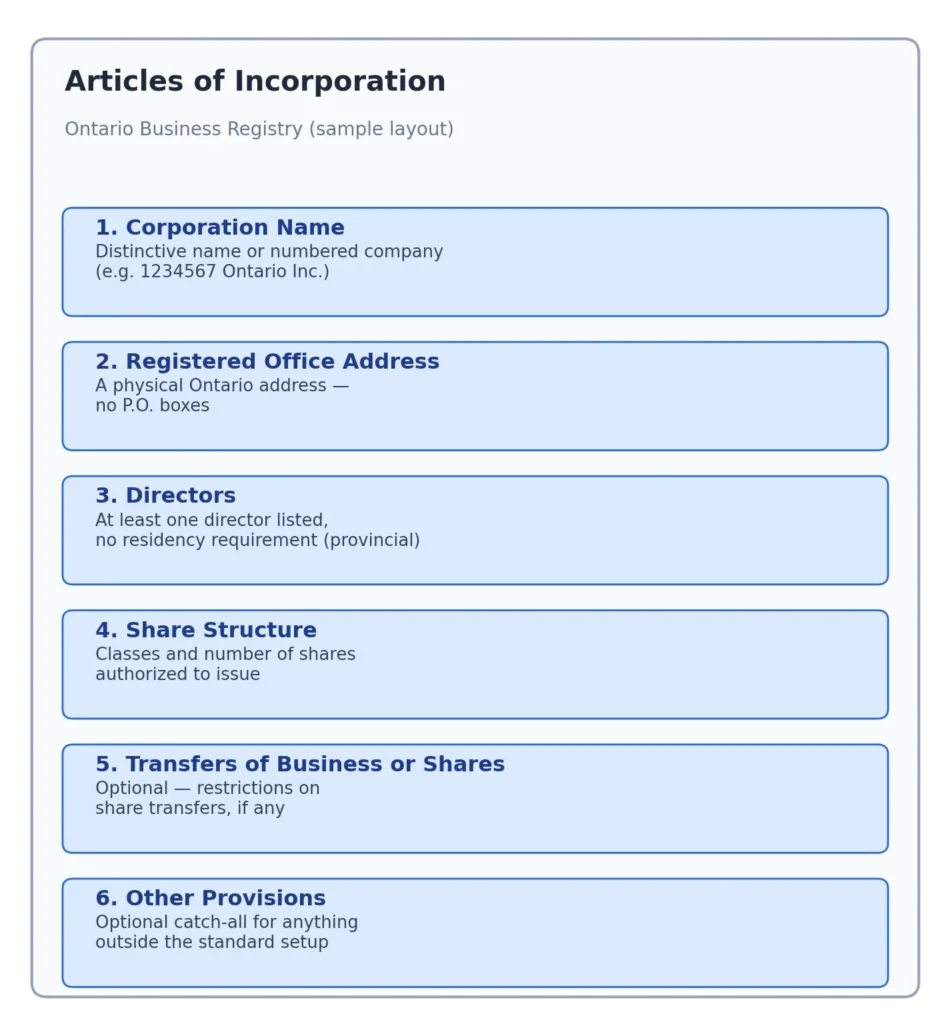
When you file, here’s what you’ll need to spell out:
1. Corporation Name
You’ll either choose a distinctive name (which requires a NUANS name search report) or opt for a numbered company like 1234567 Ontario Inc. — no name search needed and much faster.
2. Registered Office Address
This must be a physical address in Ontario (no P.O. boxes). It’s where government notices will be sent.
3. Directors:
You need at least one director listed. In Ontario, there’s no requirement for a certain percentage of Canadian residents at the provincial level — a common point of confusion.
4. Share Structure.
This trips people up the most. You’ll need to define the classes of shares your corporation is authorized to issue. A simple structure (one class of common shares, unlimited) works for most small businesses, but if you’re planning to bring on investors or split ownership, think this through carefully.
5. Transfers of Business or Shares
(optional)Many newly incorporated businesses simply do not specify anything in this section, but it might be necessary for regulated industries.
6. Other Provisions
(optional) Think of this as a catch-all for anything outside the standard setup.
How to Actually File
You have two options:
- Online via ServiceOntario — The fastest route. Filing through the Ontario Business Registry typically takes 1–2 business days.
- By mail or physically – Slower method of filing, but an option regardless of whether you want to use the paper form.
Filing cost: $300 (as of 2026) for incorporating in Ontario.
Upon receiving approval, you will get the Certificate of Incorporation together with a stamped version of your Articles. Remember to store those carefully as you will need them each time you set up a business account, secure financing, or enter into contracts.
After Your Incorporation Is Approved: Next Steps
The filing of Articles of Incorporation is just the beginning. These are the things that usually follow:
- Corporate minute book – This is something that you’ll require from day one because all your by-laws, list of shareholders, board resolutions, etc., are kept there.
- HST number – Mandatory if your estimated revenue is above $30,000.
- Business Number (BN) – Given to you by the CRA.
- Shareholders’ agreement — Not legally required, but I always recommend one if there’s more than one shareholder. It prevents a lot of future headaches.
- Annual returns — Ontario corporations must file an annual return each year to stay in good standing.
Read our complete guide on what happens after incorporating in Ontario for the full checklist.
Common Mistakes to Avoid
I’ve seen these come up again and again — don’t let them slow you down:
- Choosing a name without a NUANS search — Even if a name seems unique, you need the search report to prove it.
- Leaving the share structure too vague — “Unlimited common shares” sounds fine until you need to issue different classes to investors.
- Using a home address as your registered office — It works legally, but it becomes public record. Consider a registered address service.
- Skipping the minute book — Auditors, banks, and future buyers will ask for it. Missing records are a red flag.
- Not getting a shareholders’ agreement — If things ever go sideways with a business partner, you’ll wish you had one.
FAQs
Q1: How long does it take to file Articles of Incorporation in Ontario?
A: Online filing through the Ontario Business Registry is processed immediately, according to Ontario’s fee table. Filing by mail takes 15 business days.
Q2: How much does it cost to file Articles of Incorporation in Ontario?
A: The Ontario government fee to incorporate online is $300. With Bizincs, a provincial Ontario number company is $550 + HST, and a named company is $650 + HST (the named price includes the name search). See our pricing page for what is included.
Q3: Do I need a lawyer to file Articles of Incorporation in Ontario?
A: No. Most standard incorporations can be filed online without a lawyer through the Ontario Business Registry or a professional incorporation service like Bizincs.
Q4: Is a Certificate of Incorporation the same as Articles of Incorporation?
A: No. Your Articles of Incorporation are the document you file to create your corporation — they define your name, structure, and shares. Your Certificate of Incorporation is the government’s official confirmation that those articles were accepted. You receive both together when you file. Need a copy of your Certificate later? Here’s how to get one.
Q5: Is “Articles of Organization” the same as Articles of Incorporation?
A: No — Articles of Organization is a U.S. term used for forming an LLC, a business structure that doesn’t exist in Canada. In Ontario, the equivalent founding document is always called Articles of Incorporation.
Q6: What are Articles of Incorporation?
A: Articles of Incorporation are the legal documents that officially create a corporation in Ontario. They include details like the company name, registered office address, share structure, and the names of directors. Once filed and approved, you receive a Certificate of Incorporation.
Q7. How do I get a copy of my Articles of Incorporation in Ontario?
A: You can order a copy of your articles online through the Ontario Business Registry using your corporation’s name or Ontario Corporation Number. Ontario lists document copies at $3 per document. Federal corporations order from Corporations Canada. For the full steps, see our guide to getting a copy of your Ontario certificate of incorporation.
Q8. How do I retrieve lost Articles of Incorporation?
A: If you’ve lost your original Articles of Incorporation, you can order a certified copy online through the Ontario Business Registry (or Corporations Canada for federal corporations) using your corporation number. A small fee applies.
Quick Recap
- Articles of Incorporation officially create your Ontario corporation.
- You’ll define your name, address, directors, and share structure.
- Filing is done through ServiceOntario, with a $300 fee.
- But incorporation is only the beginning – minute books, Canada Revenue Agency filing, and shareholder agreements follow.
- Don’t cut corners when it comes to choosing names, establishing share structure, or creating paperwork.
Once you know what incorporation entails, the process becomes easy to navigate in Ontario. Choosing correctly at this stage will help to avoid future problems.
Ready to File Your Articles of Incorporation in Ontario?
Ready to file your Articles of Incorporation in Ontario? Let Bizincs handle the entire process for you — from NUANS name search to Certificate of Incorporation — all online, from $550 + HST. Start your incorporation today →