What Is a Corporate Resolution? When You Actually Need One
What Is a Corporate Resolution? When Do You Need One?
A corporate resolution is a written record of a formal decision made by a company’s directors or shareholders. Most Canadian business owners don’t think about it until a bank or lender asks, “Can we see the resolution?” Then it suddenly matters a lot. Here’s what it is, when you need one, who signs it, and how to keep it on file.
What Is a Corporate Resolution?
It’s the official record that says your company approved a specific action. What was decided, who decided it, and on what date. That’s really all it is.
Say your company wants to take out a loan, add a new signing officer, or issue shares. The resolution is the document that proves the right people agreed to it.
There are two kinds you’ll hear about most. A board resolution is a decision made by the directors, usually about running the business. A shareholder resolution is a decision made by the owners, and it tends to cover bigger changes to the company itself.
Why Is a Corporate Resolution Important?
Because it proves a decision was made properly. Without it, you’re relying on memory, or digging through old emails and hoping someone said yes in writing.
It tends to come up at awkward moments. A bank wants one before it changes who can sign on your account. A lender wants to see that the company actually approved the financing. A buyer or investor wants proof that a major transaction wasn’t just one director’s idea.
It also helps you. A tidy set of resolutions in your corporate records means you’re not piecing the story together two years later.
When Do You Need a Corporate Resolution?
You generally want one when the company makes a significant decision that someone else, or your own records, may need to rely on. Whether it’s strictly required depends on the situation, the law that governs your corporation, and your bylaws. Sometimes the law says you must. Sometimes it’s just what the bank expects. Often it’s simply good practice.
Here are the situations where resolutions show up most:
- Opening a bank account or changing signing authority
- Taking on a loan or other financing
- Issuing shares or declaring dividends
- Buying or selling major assets
- Signing a major contract or transaction
- Restructuring the corporation
- Amalgamation or dissolution
Some of these, like amalgamation or dissolution, come with specific approval rules under corporate law. Others, like a bank account change, are more about what the institution asks for. Don’t assume every item above is a legal requirement in every case.
Ordinary vs. Special Corporate Resolutions
The difference is how many votes you need. An ordinary resolution passes with a simple majority of the votes cast. A special resolution needs more, generally at least two-thirds of the votes cast.
Ordinary resolutions handle everyday stuff. Special resolutions are saved for bigger moves, like amending your articles of incorporation or approving an amalgamation.
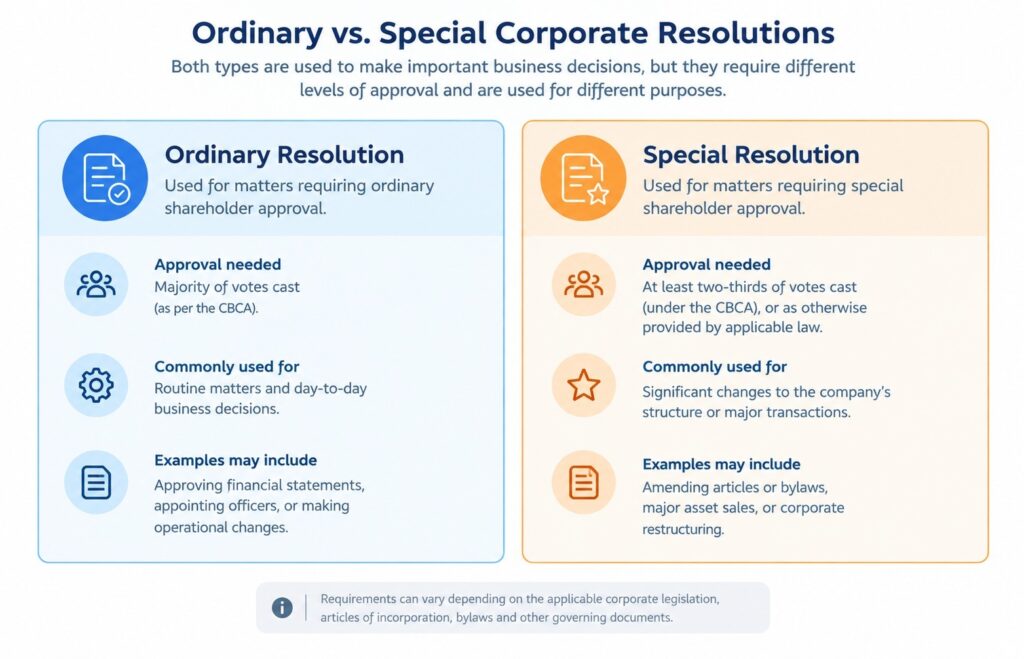
The exact rules come from your corporate statute and your bylaws, so check both before you vote.
Who Approves and Signs a Corporate Resolution?
It depends on the decision. Directors usually approve the day-to-day and financial matters. Shareholders step in when the decision changes the structure of the company.
A board of directors resolution is passed by the directors, either at a board meeting or in writing. If it’s passed at a meeting, it goes into the minutes as a board meeting resolution. If it’s done in writing, you’ll often hear it called a resolution of directors, and it’s typically signed by every director so you don’t need to hold a meeting at all.
Shareholder resolutions work the same way. They can be passed at a meeting or in writing, and they cover things like changes to the articles, amalgamation, or winding the company up.
So who actually signs? For a written resolution, usually everyone entitled to vote on it. For a meeting, the decision is recorded in the minutes. Your bylaws and any shareholder agreement spell out who holds which power, so read them before assuming.
How to Prepare a Corporate Resolution
It’s not complicated, but it helps to do it in the same order every time.
- Pin down the decision. Be specific about what’s being approved.
- Work out who has the authority, directors, shareholders, or both.
- Hold a meeting, or prepare a written resolution if that’s allowed and practical for your company.
- Record the decision clearly, with the action and the date.
- Get it signed.
- File it with your corporate records straight away.
That last step is the one people skip. Don’t.
How to Keep Corporate Resolutions on Record
Keep signed resolutions in your corporate minute book, in order, where you can actually find them. The minute book is where a Canadian corporation holds its core records, and resolutions belong there.
Keep the signed copies, not just the drafts. If you store things digitally, use secure storage and back it up. And every so often, flip through the book to make sure nothing’s missing. It’s much easier to catch a gap now than when a bank is waiting on you.
What Happens If a Corporate Decision Isn’t Properly Documented?
Mostly, you run into a proof problem. The decision might have been perfectly fine, but if you can’t show who approved it, you’re stuck explaining instead of just handing over a document.
That can mean trouble when a bank or another party asks for documentation and you’ve got nothing to give them. It can leave gaps in your corporate records that are annoying to fix after the fact. And it can create uncertainty inside the company, because two people can remember the same decision very differently.
The good news is the fix is simple. Write decisions down when they happen.
When Should You Get Legal Help?
When the stakes are high or the situation is messy. A lawyer can confirm who needs to approve something and how the resolution should be worded.
It’s worth a conversation for major transactions, shareholder disputes, corporate restructuring, amalgamation or dissolution, and complex financing. For routine matters, a well-prepared resolution is often enough on its own.
Frequently Asked Questions
What is a corporate resolution?
It’s a written record of a formal decision approved by a company’s directors or shareholders.
When is a corporate resolution required?
It depends on the decision, the statute that governs your corporation, and your bylaws. Banks, lenders, and other parties often ask for one, and some decisions have specific approval rules.
Who approves a corporate resolution?
Directors usually approve operational and financial decisions. Shareholders approve major structural ones. Your bylaws and corporate statute fill in the details.
What is a board resolution?
It’s a decision approved by the board of directors, either at a meeting or in writing.
Who signs a corporate resolution?
That depends on how it’s passed. A written resolution is typically signed by everyone entitled to vote on it. A resolution passed at a meeting is recorded in the minutes.
Where should a corporate resolution be kept?
In your corporate minute book, with signed copies stored securely and backed up.
Quick recap:
- A corporate resolution is your proof that a decision was properly approved.
- Directors and shareholders each handle different kinds of decisions.
- Ordinary resolutions need a majority, special ones need roughly two-thirds.
- Keep signed copies in your minute book.
- Talk to a lawyer when the decision is big or complicated.
Want help keeping your corporate records in order? Bizincs offers quick, professional support for Canadian businesses.