
Should You Incorporate or Stay a Sole Proprietor in 2026?
Most Canadian sole proprietors are one bad year away from a decision they’ll wish they made sooner.
Quick answer: if your business is growing, carrying any real risk, or making enough that your personal tax rate is starting to sting, incorporating is usually worth it in 2026. If you’re still testing an idea, working part time, or earning under roughly $50,000 in net income, staying a sole proprietor is often the smarter, cheaper call for now.
That’s the short version. But “usually” and “often” aren’t good enough when it’s your business and your money on the line, so let’s actually walk through it. I’ve helped enough business owners make this exact call to know the real answer depends on your numbers, not on what worked for your cousin’s friend.
5 Myths About Incorporating, Debunked
Let’s clear these up first, because half the hesitation around incorporating comes from outdated advice.
Myth 1: “Incorporating is only for big companies.” Not true at all. Plenty of one-person consulting businesses, contractors, and online sellers incorporate specifically because they’re small and want the liability protection before something goes wrong, not after.
Myth 2: “It’s too expensive to bother with.” Government filing fees in most provinces sit in the $275 to $395 range as of 2026. That’s a one-time cost, not a monthly one. It’s a lot less than most people assume.
Myth 3: “I’ll lose control of my business.” You won’t. As the sole shareholder and director, you still make every decision. Incorporating changes your legal structure, not who’s in charge.
Myth 4: “Sole proprietors don’t need to worry about liability.” This one worries me the most, honestly. As a sole proprietor, there’s no legal separation between you and your business. If your business gets sued or can’t pay a debt, your personal assets, including your house and savings, are on the table.
Myth 5: “I can incorporate later, so why rush?” You can, but “later” often means after a bad year, a lawsuit scare, or a client contract that specifically requires you to be incorporated. Waiting for a crisis to force the decision is exactly the trap the hook line above is talking about.
The Real Costs and Real Savings (2026 Numbers)
Here’s where people either overestimate or underestimate the cost, and both mistakes lead to bad decisions.
Government filing fees by province (2026):
| Province | Incorporation Fee | Notes |
| Ontario | $300 (online, OBCA) | Federal option available at $200 |
| British Columbia | ~$351.50 to $380 | Includes $30 name request for a named company |
| Alberta | $275 | Must file through a registry agent, no direct government portal |
| Manitoba | $350 to $395 | Named corporations need a $45 name reservation |
Add a NUANS name search (roughly $15 to $80 depending on province), and most people land somewhere between $300 and $450 all in for a basic, named provincial corporation. That’s the whole “expensive” myth debunked right there.
Now the savings side. This is what actually makes incorporating worth it for a lot of business owners. Canadian-controlled private corporations that qualify for the small business deduction pay a federal rate of just 9% on the first $500,000 of active business income, plus a small provincial top-up that varies by province. Compare that to personal income tax rates, which climb well past 40% at higher income brackets. If you’re leaving profit in the business to reinvest rather than pulling it all out as personal income, that gap adds up fast.
The honest caveat: if you’re taking every dollar out of the business anyway, some of that corporate tax advantage disappears once it’s taxed again as personal income. This is exactly why “should I incorporate” isn’t a one-size answer, and it’s exactly what the quiz below is built to sort out.
A Real-World Comparison
Let’s put this in a real scenario instead of talking in the abstract.
Meet Sarah, a freelance graphic designer in Ontario earning $85,000 net per year as a sole proprietor. She reinvests about $20,000 of that back into new equipment and software each year, and takes the rest as personal income to live on.
As a sole proprietor, that full $85,000 gets taxed at her personal rate, which pushes a chunk of it into a higher bracket. She also has zero separation between her business and personal assets, so if a client dispute ever escalated into legal action, her personal savings would technically be exposed.
If Sarah incorporated, the $20,000 she reinvests each year could stay inside the corporation and get taxed at the roughly 9 to 12% small business rate instead of her personal rate. On the $65,000 she draws out to live on, she’d still pay personal tax on that portion, so incorporating doesn’t erase her personal tax bill entirely. What it does is shrink the tax hit on the money she’s not touching anyway, while also putting a legal wall between her business and her house.
For Sarah, incorporating made sense once her reinvested amount grew large enough that the tax savings outweighed the $300 filing fee and the extra bookkeeping. That threshold is different for everyone, which is exactly why we built the quiz below instead of giving you a flat dollar figure.
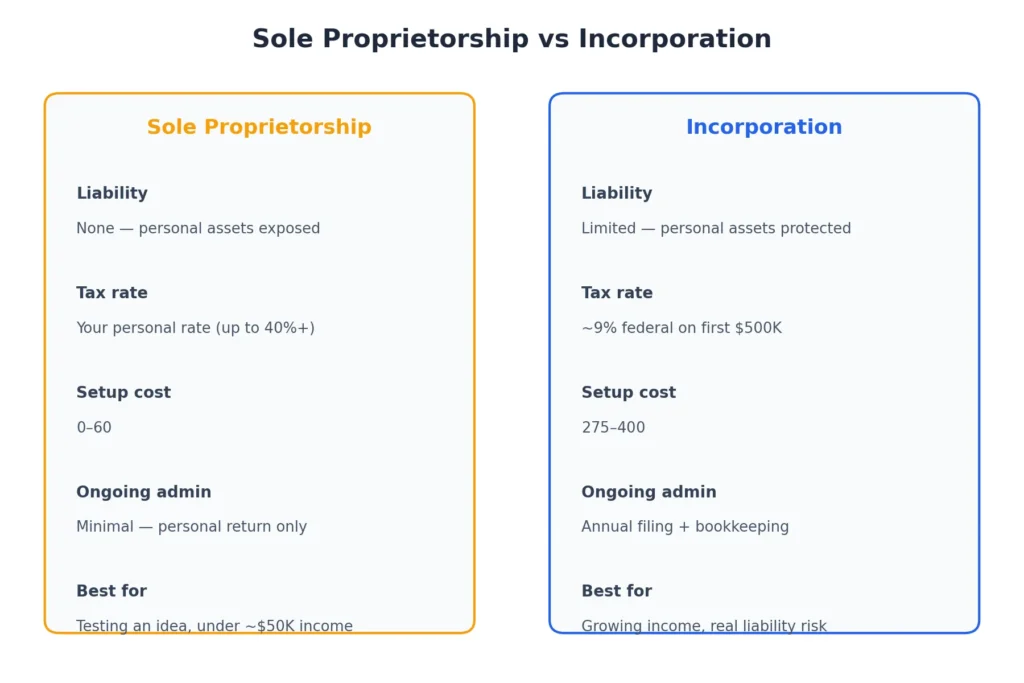
Sole Proprietorship vs Incorporation: Side-by-Side
| Sole Proprietorship | Incorporation | |
| Liability | None — personal assets exposed | Limited — personal assets protected |
| Tax rate | Your personal rate (up to 40%+) | ~9% federal on first $500K (small business rate) |
| Setup cost | $0–$60 | $275–$400 |
| Ongoing admin | Minimal — personal tax return only | Annual corporate filing, bookkeeping |
| Best for | Testing an idea, under ~$50K net income | Growing income, real liability risk, reinvesting profit |
Which One Fits You? Take the 60-Second Quiz
Answer these six questions honestly and you’ll get a much clearer read on where you actually stand.
1. How much net income does your business bring in per year? A) Under $30,000 B) $30,000 to $75,000 C) Over $75,000
2. How much of that income do you reinvest back into the business, rather than take home? A) Almost none B) Some, but I take most of it home C) A meaningful chunk every year
3. Does your work carry any real risk of being sued or facing a legal claim? A) Very low risk B) Some risk (client contracts, physical work, advice-based services) C) High risk (large contracts, physical products, safety-related work)
4. Have any clients or contracts required you to be incorporated? A) No B) Not yet, but it’s come up C) Yes, or I expect it soon
5. How do you feel about extra bookkeeping and an annual corporate tax filing? A) I’d rather avoid the extra admin for now B) I’m willing to do it if the savings are worth it C) I already have a bookkeeper or accountant in place
6. Are you planning to bring on a business partner, investor, or sell the business down the line? A) No plans like that B) Maybe eventually C) Yes, that’s part of the plan
Mostly A’s: Stay a sole proprietor for now. Your income and risk level don’t yet justify the extra cost and admin of incorporating. Revisit this once your numbers grow.
Mostly B’s: You’re in the gray zone, and that’s actually the most common spot to be in. Incorporating could go either way depending on your specific numbers. This is worth a quick conversation with someone who can run your actual figures.
Mostly C’s: Incorporate. Between the income level, the reinvestment, the risk exposure, or the contract requirements, the case for incorporating is already strong. Waiting is likely costing you money or exposing you to risk you don’t need to carry.
FAQ
How much does it cost to incorporate in Ontario?
$300 for a provincial online filing through the Ontario Business Registry, or $200 for a federal incorporation. Add a NUANS name search, typically $15 to $80, if you want a named rather than numbered company.
How much does it cost to incorporate in BC?
Budget roughly $380 total for a named provincial corporation: $30 for the name request plus $351.50 for the incorporation filing. A numbered company skips the name request and runs about $351.50.
How much does it cost to incorporate in Alberta?
The government fee is $275, but Alberta requires filing through an authorized registry agent rather than a direct government portal, so factor in the agent’s service fee on top of that.
How much does it cost to incorporate in Manitoba?
$350 for a numbered corporation, or around $395 for a named one once you add the $45 name reservation fee.
How long does incorporating actually take?
For most provinces, the filing itself can be same-day or near-instant once your name is approved. The name approval step is usually the bottleneck, often taking anywhere from a few days to two weeks depending on the province and whether you pay for priority processing.
Here’s what to take away from all this:
- Government fees to incorporate in Canada usually land between $275 and $400, far less than most people expect
- The tax advantage really shows up when you’re reinvesting profit, not just when you’re earning more
- Sole proprietorship offers zero legal separation between you and your business, which matters more than most people realize until something goes wrong
- Clients requiring incorporation, growing income, and rising liability risk are all signs it’s time to stop putting it off
- If you’re not sure where you land, the quiz above (or a quick conversation with us) will tell you faster than guessing will
Get your personalized incorporation recommendation and start today for as little as $100, with Bizincs.