Ontario Business Registration: Complete 2026 Guide (7 Steps)
Starting a business in Ontario is exciting. The first critical step is Ontario business registration. This process makes your business official. It creates a legal identity for your venture. Proper registration is not optional. It is a legal requirement in most cases. This guide covers all the steps for Ontario business name registration in 2025. It details how to use the Service Ontario business registration platform. Getting this right sets a strong foundation for your success.
What Is Business Registration in Ontario?
Business registration is the act of formally recording your business with the provincial government. It provides official recognition. This process ensures compliance with the Business Names Act.
When is it required?
You need to register if you are operating under a business name that is not your own legal name. This applies even to sole proprietors. For example, if your name is Jane Doe, you don’t need to register if you operate as “Jane Doe.” However, if you call your business “Jane’s Consulting Services,” business name registration is mandatory. This also applies to partnerships and corporations. This registration is done through the official Service Ontario business name registration process.
Important legal consequence: An unregistered business cannot maintain a legal proceeding in an Ontario court under its unregistered name. That means if a client doesn’t pay you, you cannot sue under your business name until your registration is in order. Don’t let this happen to you.
Types of Business Structures in Ontario
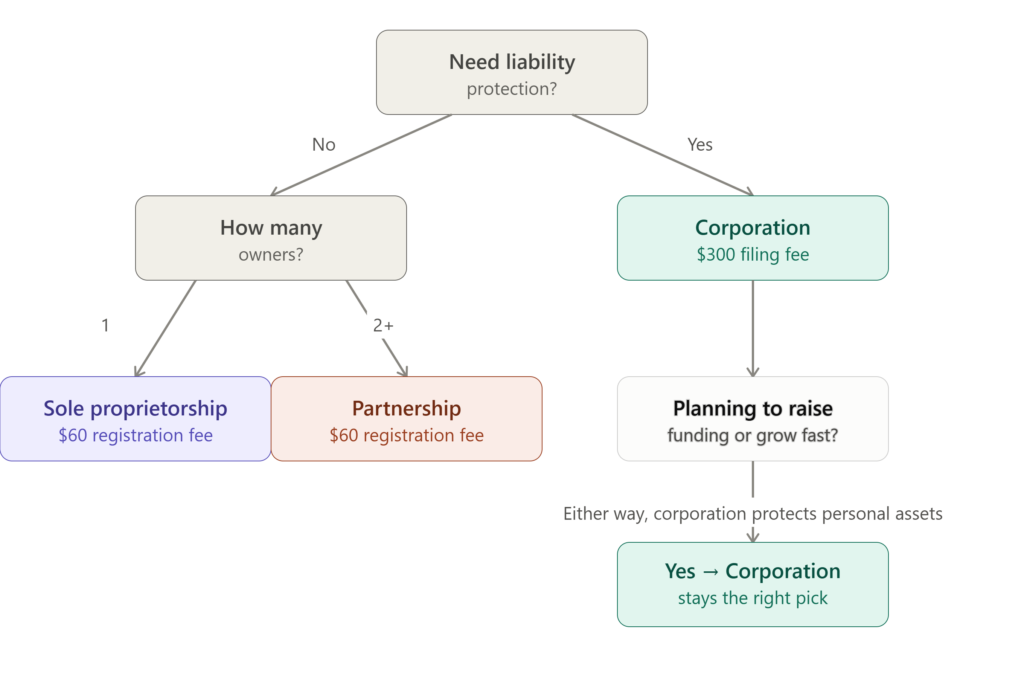
Choosing the right legal structure is key. It affects liability, taxation, and administration. Ontario offers three main structures.
Comparison Table
| Sole Proprietorship | Partnership | Corporation | |
| Liability | Unlimited — you’re personally responsible | Unlimited — each partner personally liable | Limited — personal assets protected |
| Taxation | Personal tax return (T1) | Each partner’s personal return | Separate corporate return (T2) |
| Setup cost | $60 registration fee | $60 registration fee | $300 filing fee |
| Best for | Solo freelancers, testing an idea | Two or more owners sharing a simple business | Anyone wanting liability protection or planning to grow/raise funding |
Sole Proprietorship
- Definition: This is the simplest structure. It is owned and controlled by one person.
- Liability: You and your business are legally one entity. You are personally responsible for all business debts. This is known as unlimited liability.
- Taxation: Business income is reported on your personal tax return (T1).
- Registration: If you use a name other than your own, you must register the sole proprietorship Ontario business name.
Partnership
- Definition: Two or more individuals share ownership. They operate the business for profit.
- Liability: Similar to a sole proprietorship, partners are personally liable for business debts. Each partner can be responsible for the full amount.
- Taxation: Each partner reports their share of the partnership’s income on their personal tax return.
- Types: There are General Partnerships and Limited Partnerships (LP). LPs offer some limited liability to passive partners.
Corporation
- Definition: This is a separate legal entity. It is distinct from its owners (shareholders).
- Liability: Shareholders have limited liability. Their personal assets are generally protected from business debts.
- Taxation: The corporation pays its own taxes. This is done on a separate corporate tax return (T2). Owners who work for the corporation are taxed as employees.
- Setup: This is the most complex and costly structure to set up.
Ready to actually incorporate your business rather than just register a name? See our full step-by-step incorporation guide.
Which Ontario Business Structure Is Right for You?
How to Register a Business Name in Ontario
The registration process is largely completed online. The official portal is the Ontario Business Registry (OBR). This ensures a fast and efficient process.
Step-by-Step Registration
- Choose Your Name: Select a unique and compliant name. Check that it follows naming rules. For corporations, a more extensive NUANS name search report is often required.
- Access the Ontario Business Registry: Visit the official OBR portal. You will need a My Ontario Account to access it. If your business was registered before October 19, 2021 (the OBR launch date), your information was migrated from the old system. You still need to set up an Ontario Business Account and use your company key (a unique 9-digit code) to link your entity to your account going forward.
- Select Your Filing: Choose the specific transaction. This could be “Register a Sole Proprietorship” or “Incorporate a Business Corporation.”
- Complete the Form: Enter all required details accurately. This includes the business name, address, business activity, and owner information.
- Pay the Fee: The fee depends on the business structure. A business name registration for a sole proprietorship is currently $60. Fees are paid online.
- Get Your Master Business Licence (MBL): Once complete, you receive confirmation and your MBL. This document includes your Business Identification Number (BIN). This is proof of your service Ontario business name registration.
- Keep Information Updated: You are legally required to update your information in the OBR within 15 days of any change to your business details. The government uses your registered email address for official notices, so keep it current.
What Is a Master Business Licence (MBL) in Ontario?
Your Master Business Licence (MBL) is the official document you receive once your business name registration is approved — think of it as your proof of registration. It includes your business name, your Business Identification Number (BIN), and the date your registration expires.
An MBL is valid for 5 years from the date of issue. After that, it doesn’t renew automatically — you’ll need to log back into the Ontario Business Registry and file a renewal before it lapses, or your business name registration becomes invalid and someone else could legally register the same name.
Corporations do not have a five-year renewal, but they must file annual returns through the OBR to remain in good standing. Missing annual filings can result in your corporation being dissolved by the province.
Getting Your Ontario Business Number (BN)
The registration process gives you a Business Identification Number (BIN) from the province. However, a separate number is also essential. This is the federal Ontario Business Number (BN).
The BN is a unique 9-digit identifier. The Canada Revenue Agency (CRA) issues it. You need it to deal with federal programs. This includes GST/HST, payroll, and corporate income tax.
Business Identification Number (BIN) vs. Business Number (BN): What’s the Difference?
These two numbers get confused constantly, so here’s the simple breakdown:
Your BIN comes from the province the moment you register your business name or incorporate through the Ontario Business Registry. It’s printed right on your Master Business Licence and is really just a provincial reference number — Ontario uses it to identify your registration in its own system.
Your BN comes from the CRA (a federal agency, not the province) and is what actually connects your business to federal programs — GST/HST, payroll deductions, and corporate income tax all run through your BN, not your BIN.
For corporations, the BN is often issued automatically right after incorporation. For sole proprietorships and partnerships, you’ll usually need to apply for the BN separately with the CRA — and when you do, you’ll be asked for your provincial registration details, including your BIN.
In short: BIN = Ontario knows you exist. BN = the CRA knows you exist. You need both to legally operate.
Also read: How to Obtain a Business Number (BN) in Canada
Online Registration via Service Ontario
Online registration is now the standard for Service Ontario business registration. The portal provides a seamless experience.
Process Summary
You register through the Ontario Business Registry. It is accessed via the ServiceOntario website. You can complete the process for:
- Sole proprietorships
- General partnerships
- Corporations (incorporation)
Fees and Documents
The registration fee is non-refundable.
| Business Type | Fee (Approx.) | Renewal Required |
| Sole Proprietorship | $60 | Every 5 years |
| General Partnership | $60 | Every 5 years |
| Corporation (Provincial, online) | $300 | Not for renewal, but annual filings are required |
| Limited Liability Partnership (LLP) | $60 | Every 5 years |
| Ontario Limited Partnership | $210 | — |
| NUANS Name Search Report | $13–$60 | Per use (valid 90 days) |
Key cost notes:
- All registration fees are non-refundable, regardless of outcome.
- Corporations incorporating with a chosen name must obtain a NUANS report before filing. This confirms your name is unique and doesn’t conflict with existing registered names across Canada. The report is valid for 90 days.
- Choosing a numbered company (e.g., “1234567 Ontario Inc.”) skips the NUANS requirement, reduces cost, and speeds up incorporation. Many businesses start this way and register a trade name separately later.
- Third-party licensed service providers typically charge an additional $100–$400 in service fees on top of government fees.
- Failure to register when required can result in fines of up to $2,000 for individuals or $25,000 for corporations under the Business Names Act.
- Mail-in submissions cost the same as online but take approximately 15 business days to process compared to immediate processing online. There is no good reason to file by mail if you need your registration quickly.
Documents/Information required usually include:
- Proposed business name registration details.
- Owner/Partner/Director names and residential addresses.
- The primary business address in Ontario.
- A valid email address.
- Credit or debit card for the fee payment.
You get immediate confirmation after online submission. This fast process makes service Ontario business name registration highly efficient.
Ontario Business Registration for Immigrants and Newcomers
Ontario business registration for immigrants follows the same process as for Canadian citizens. The Ontario Business Registry does not have a separate system based on immigration status.
However, there are important eligibility and practical considerations newcomers must understand first.
Who can register a business in Ontario?
You can register if you are:
- A Canadian citizen or permanent resident
- A temporary resident with a valid work permit that authorizes self-employment
- A foreign national operating through a corporation (specific rules apply per your immigration category)
If you are uncertain whether your immigration status permits self-employment, contact Immigration, Refugees and Citizenship Canada (IRCC) at 1-888-242-2100 before investing time or money in the registration process. They are the only authority that can officially confirm your eligibility.
Practical steps for newcomer entrepreneurs:
- Confirm eligibility with IRCC before registering.
- Check regulated profession requirements. If your field is regulated in Ontario (e.g., engineering, medicine, real estate, accounting), you may need a license or professional certification before operating. Contact Global Experience Ontario at 1-866-670-4094 for guidance.
- Register through the OBR. The same online portal all Ontario businesses use. There is no separate process.
- Access free legal support. Pro Bono Ontario (1-855-255-7256) offers free legal advice for those who cannot afford a lawyer. The Law Society of Ontario provides a referral service for business law questions.
Ontario Immigrant Nominee Program (OINP)
Ontario offers dedicated immigration pathways for entrepreneurs through the OINP Entrepreneur Stream. This targets foreign nationals who want to start or purchase and operate a business in Ontario.
Requirements typically include prior business or management experience and minimum investment thresholds. Nominees can receive provincial nomination toward Canadian permanent residence.
Always verify current stream availability and requirements on the official OINP website, as programs open and close periodically.
For most newcomers, sole proprietorship Ontario registration is the fastest and most affordable way to begin operating legally. It costs $60 and takes minutes online.
After Registration What Comes Next?
Your initial Ontario business registration is complete. Now you must address other requirements.
Taxation and the CRA
The first step is securing your Ontario business number (BN) from the CRA. You must then register for federal program accounts.
- HST/GST: You must register for an HST account if your worldwide revenue exceeds $30,000 in any single calendar quarter or over four consecutive quarters.
- Payroll: If you plan to hire employees, you must register a payroll account with the CRA. This is for source deductions.
WSIB Registration
The Workplace Safety and Insurance Board (WSIB) provides insurance. It covers employees for work-related injuries or illnesses. Most Ontario businesses with employees must register with WSIB. There are some industry exemptions.
Permits and Licenses
Provincial registration does not cover local rules. Check your specific municipality for required permits or licenses. Your business activity may also require industry-specific permits.
Proper CRA business registration is the foundation for all future filings. Always keep your registration documents safe.
Post-Registration Checklist
Registering is just the starting line. To stay compliant and protected, work through this list:
- Open a Business Bank Account — never mix personal and business finances. You’ll need your Articles of Incorporation or Business Name Registration, your BN, and two pieces of government ID.
- Set Up a Minute Book (Corporations) — legally required if you incorporated. Includes your bylaws, share certificates, and director meeting records. Skipping this causes problems during audits or if you sell the business.
- Register with WSIB Within 10 Days of Hiring — if you plan to hire employees (including family members), most Ontario businesses are legally required to carry this insurance.
- Get Business Insurance — not always legally mandatory, but General Liability Insurance is strongly recommended. If you work from home, check with your provider — standard home insurance usually excludes business claims.
- Set Up Bookkeeping From Day One — track every receipt and invoice, whether through software like QuickBooks or a professional bookkeeper.
- Check BizPaL for Industry-Specific Permits — confirms if your specific niche needs additional municipal permits (health permits for food, signage permits for a storefront, etc.)
FAQs
How long does Ontario business registration take?
Online Ontario business registration is usually very fast. Sole proprietorships and partnerships can be registered immediately. You receive your Master Business Licence right away. Corporate incorporation takes a bit longer. It is often completed within one to three business days online.
Is business name registration the same as getting a business number?
No, they are different. Business name registration is a provincial requirement. It registers your operating name. The ontario business number (BN) is a federal number. The CRA issues it for tax and federal program purposes. You need both to operate legally.
How do I register a sole proprietorship in Ontario?
You register a sole proprietorship in Ontario online. Use the official Ontario Business Registry portal. You select the Sole Proprietorship option. You provide your personal details, the business name, and the address. You then pay the $60 registration fee.
Is there an LLC option in Ontario?
No — Canada doesn’t have an LLC (Limited Liability Company) structure the way the U.S. does. If you’re looking for that kind of limited liability protection, the closest equivalent in Ontario is a Corporation. If you just want something simple to start with and don’t need liability protection yet, a Sole Proprietorship or Partnership is the equivalent starting point. Learn the difference between corporation and incorporation to see which fits your situation.
Conclusion
Completing your Ontario business registration is a major milestone. It is a legal obligation and a necessary step. It legitimizes your business. It allows you to operate confidently in the province. Understanding the structures and following the steps correctly is vital. Take your time to choose the right structure and complete all filings with accuracy.
Need help with your Ontario business registration? Visit Bizincs.com for expert assistance.