How to Close a Business in Ontario Without Penalties (7-Step Checklist)
Shutting down a business in Ontario isn’t as simple as locking the doors and walking away. Whether you’re a sole proprietor, a partnership, or a corporation, there are legal and tax-related obligations you must fulfill to dissolve your business properly.
This guide covers how to dissolve a corporation in Ontario, cancel your business registration, file your final tax return for an Ontario corporation, and meet every compliance step. With expert-backed resources and step-by-step clarity, you’re in good hands. Need stress-free help? Bizincs makes it simple from start to finish.
Steps to Close Your Ontario Business
Before closing a business in Ontario, it’s essential to understand the right process based on your business type. From board resolutions to CRA account closures, here are Ontario business closure steps in the correct way, whether you’re incorporated or registered as a sole proprietor or partnership.
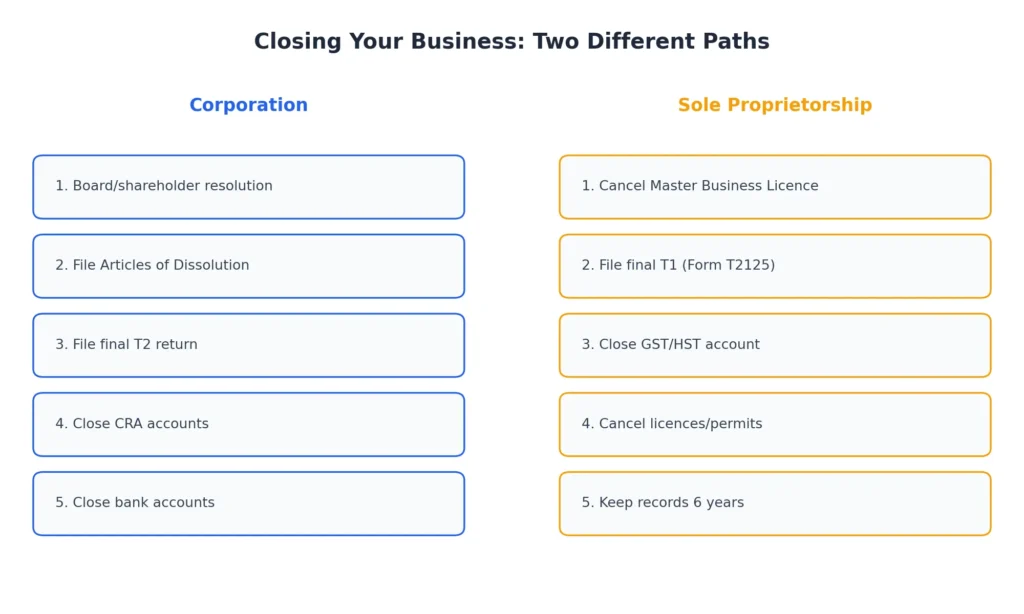
Step 1: Assess Your Business Structure and Goals
- Corporations require Articles of Dissolution and tax clearances.
- A Sole Proprietorship/Partnership can cancel your Master Business Licence (MBL) through ServiceOntario.
- Decide whether you are permanently closing or planning a merger/sale.
- Consult any stakeholders or partners before starting the process.
Step 2: Obtain Legal Approval or Consent
- Corporations must pass a resolution of the shareholders or the board of directors authorizing the dissolution.
- In partnerships, all partners must consent in writing.
- Fulfill any legal obligations that might be outlined in your operating agreement.
Step 3: File for Official Dissolution or Cancellation
- To dissolve a corporation in Ontario, you must file Articles of Dissolution through the Ontario Business Registry using your Ontario Corporation Number (OCN) and Company Key.
- Sole proprietors/partnership owners will cancel their registration using a form titled “Change of Business Information” on ServiceOntario.
- Fees range from CAD 0 to 30 under the dissolution or cancellation type and its means of delivery.
Step 4: Notify the Canada Revenue Agency (CRA)
- Next, you need to submit your final T2 corporate tax return to make sure all your tax accounts are closed.
- File your final GST/HST return by using Form RC145 and remit any amounts owing.
- Close your payroll and import/export accounts through your CRA Business Account.
- Ensure that all amounts owing concerning taxes are fully paid.
Step 5: Notify Employees, Stakeholders & Creditors
- Provide notices and severance, if applicable, following Ontario Employment Standards.
- Notify suppliers, lenders, customers, and contractors in writing.
- Settle all outstanding debts, leases, and obligations.
Step 6: Close Bank Accounts and Cancel Licences
- Close all business-related bank accounts and credit lines.
- Cancel municipal licences, sector-specific permits, and utility registrations.
- Make sure you keep receipts and closure confirmations for your records.
How to Close a Business Bank Account in Ontario
Closing your business bank account isn’t just about walking into a branch — do it in this order to avoid bounced payments or frozen funds:
- Settle all outstanding cheques, pre-authorized debits, and pending transactions first.
- Update or redirect any automatic payments (payroll, supplier invoices, subscriptions) to avoid failed transactions after closing.
- Withdraw or transfer the remaining balance to a personal or new account.
- Request written confirmation of closure from your bank for your records — CRA and future audits may ask for it.
- Do this only after your final tax filings are settled, since refunds or CRA debits may still hit the account.
Step 7: Preserve Your Records
- Keep corporate records, tax documents, and CRA correspondence for at least 7 years.
- Secure both digital and paper copies in a reliable storage system. Consider downloading a Corporate Profile Report for final documentation.
Checklist Before You Close Your Ontario Business
Here’s a quick rundown to ensure you don’t miss any critical steps:
- Obtain dissolution resolution (corporation/partnership)
- File Articles of Dissolution or cancel your registration
- Notify CRA and close all tax-related accounts
- Pay off all outstanding debts and payroll obligations
- Notify stakeholders and terminate contracts
- Cancel permits, licences, and subscriptions
- Close business bank accounts and credit lines
- Secure final legal and financial records
- Keep CRA and financial data for 7 years
Check Out: Tax Filing Deadlines Every Business Owner Needs to Know
How to Close a Sole Proprietorship in Ontario
Closing a sole proprietorship is simpler than dissolving a corporation, but skipping steps still causes problems later:
- Cancel your Master Business Licence (MBL) through ServiceOntario using the “Change of Business Information” form — this officially ends your business name registration.
- File your final personal tax return (T1) reporting any remaining business income, using Form T2125.
- Close your GST/HST account with the CRA if you were registered, and file a final return.
- Cancel any business licences or permits tied to your registration.
- Keep your records for at least 6 years, even though you’re no longer operating.
Since a sole proprietorship isn’t a separate legal entity, there’s no “dissolution” step like a corporation needs — cancelling your registration and filing your final return is all that’s legally required.
Legal Obligations After Business Closure
Once the closure of the business is announced, other responsibilities to canceling business registration in Ontario:
- CRA Audits: You can be audited years after the closing. Keep all relevant documents or receipts.
- Unclaimed Liabilities: While settling, opposing parties, like past creditors or employees, may raise their issues. Hence, get proper documentation.
- Ongoing Legal Claims: If your company has been involved in litigation, you might still have to respond to some matters even if it is closed.
- Final Filing Review: CRA may review a reassessment of your final filing. Keep accessible in terms of mailing or digital contacts.
- Record Keeping: CRA requires the retention of all books, records, and filings for six to seven years following business closure.
Check Out: Choosing the Right Legal Form For Your Business in Canada
Conclusion
A closed Ontario business requires you to go through a series of procedures. A final tax return for Ontario corporations and operational processes must be laid out. Whatever means are used in closing your corporation or canceling your sole proprietorship, following the above legal steps will ensure that you have been protected under the law and financially. You are required to keep your records organized and inform the CRA as needed.
Need help? Bizincs offers a complete solution for all the filings and timelines needed to make this transition straightforward and professional.
FAQs
What is the typical time frame for dissolving a business in Ontario?
If all documents are filed correctly, ServiceOntario processes corporate dissolutions in a few business days. CRA account closures may take longer, depending on reviews.
Can I dissolve my Ontario business without legal help?
Yes, but expert assistance can prevent costly errors, especially with CRA, licensing, and documentation. Legal help isn’t mandatory, but it is recommended for corporations.
Do I need to file a final tax return if I cancel my business?
Absolutely. A final return (T2 for corporations or T1 for sole proprietors) must be filed, including HST and payroll summaries if applicable.
Is there a simple checklist I can follow to close my business?
Yes — at a minimum: get formal approval from partners/shareholders, file your Articles of Dissolution (or cancel your Master Business Licence), submit your final tax return to the CRA, close your bank accounts, cancel any licences or permits, and keep all records for 7 years. The full checklist above walks through each step in order.
Do I need to formally dissolve a sole proprietorship the way I would a corporation?
No. A sole proprietorship has no separate legal existence, so there’s nothing to “dissolve.” You simply cancel your Master Business Licence with ServiceOntario and file your final T1 return — no Articles of Dissolution required.