
What Happens If You Miss Your Corporate Tax Filing Deadline
You missed the deadline. Here’s exactly what the CRA does next, and how fast the clock starts ticking.
What Is Your Actual Corporate Tax Filing Deadline?
Every Canadian corporation has to file a T2 Corporation Income Tax Return within six months of its fiscal year end. If your fiscal year ends on December 31, your filing deadline is June 30. If it ends on any other day, count six months forward and that’s your date.
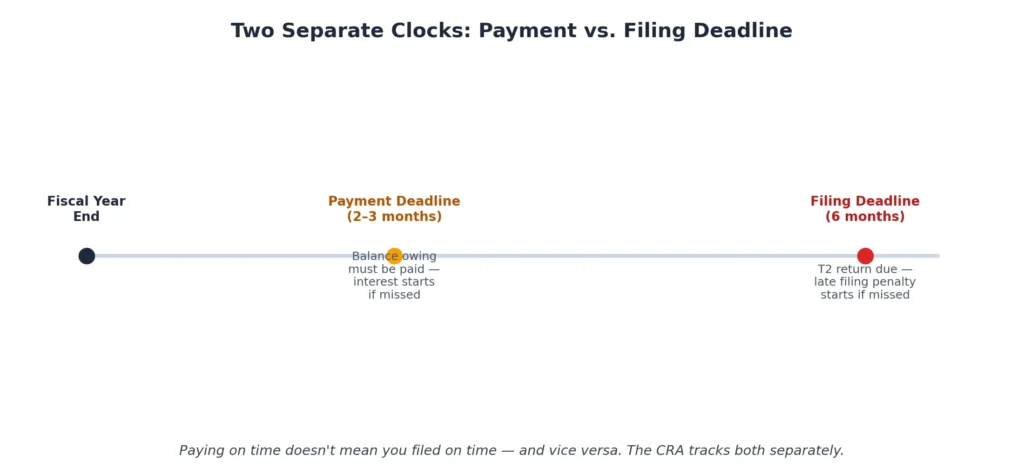
Here’s the part that trips people up. Filing and paying are two different deadlines. Most corporations, especially CCPCs claiming the small business deduction, have to pay any balance owing within three months of their fiscal year end, well before the six month filing deadline even arrives. Larger corporations or those that don’t qualify for the small business deduction usually face a two month payment deadline instead.
So it’s entirely possible to file on time and still owe interest, because you paid late even though you filed on time. And it’s possible to pay on time but still get hit with a filing penalty because the return itself showed up late. These two clocks run separately, and the CRA tracks both.
The Moment You Miss It: What CRA Does First
Nothing dramatic happens on day one. There’s no phone call, no letter in the mail that afternoon. What actually happens is quieter and more automatic. The CRA’s system flags the account the day after the deadline passes, and if there’s unpaid tax, the penalty and interest calculations start running in the background immediately.
You won’t necessarily hear from the CRA right away. Notices of assessment, penalty statements, and any formal demand to file typically arrive weeks or months later, once your return is processed or once the CRA decides to follow up. By the time you see a number on paper, the penalty has usually already been calculated in full for the months that have passed.
This is why so many business owners are caught off guard. The silence between missing the deadline and getting an actual bill makes it feel like nothing is happening, when in reality the cost is accumulating the entire time.
How Much the Penalty Actually Costs You
For a first time late filer, the CRA charges 5% of the unpaid tax owing on the filing deadline, plus 1% of that unpaid amount for every complete month the return stays unfiled, up to a maximum of 12 months.
Here’s what that looks like in real dollars on a $20,000 balance owing.
| Months Late | Penalty Rate | Penalty Owed |
| 1 month | 5% + 1% | $1,200 |
| 3 months | 5% + 3% | $1,600 |
| 6 months | 5% + 6% | $2,200 |
| 12 months | 5% + 12% | $3,400 |
That’s the penalty alone. It doesn’t include the interest that’s building on top of it, which we’ll get to next.
Repeat Offender? The Penalty Doubles
If the CRA has issued a formal demand to file your return, and you were also charged a late filing penalty in any of the previous three tax years, the penalty structure changes completely. Instead of 5% plus 1% a month, you’re looking at 10% of the unpaid tax plus 2% for every complete month late, up to a maximum of 20 months.
Think of it as the CRA’s version of a second strike rule. The first time you’re late, the system treats it as a one off. The second time within a three year window, it assumes the pattern is intentional or at least habitual, and the penalty math reflects that. On that same $20,000 balance, a repeat offender filing 12 months late would owe $6,800 in penalties alone, roughly double what a first time filer pays.
Interest Keeps Compounding Even If You Can’t Pay
This is the part most owners don’t fully grasp until they see the actual balance. The penalty is a one time charge calculated once. Interest is not. The CRA charges compound daily interest on any unpaid balance, starting the day after your balance due date, and it keeps compounding every single day until the full amount is paid off, including the penalty itself.
As of the third quarter of 2026, the CRA’s prescribed rate on overdue taxes sits at 7% annually. Because it compounds daily rather than monthly or annually, the real cost creeps up faster than a simple 7% figure suggests. Even if you genuinely cannot pay the tax you owe, filing your return on time still matters, because the late filing penalty only applies to the return, while interest applies to the unpaid balance regardless of whether you filed or not. Filing late and paying late are two separate problems that stack on top of each other.
Does This Affect Your Personal Credit or Assets?
This is where a lot of misinformation floats around. The short answer is that a corporation missing its tax filing deadline does not directly hit your personal credit score, and the corporate veil, the legal separation between you and your business, generally still holds for tax debt.
The CRA typically pursues the corporation itself first, through liens, garnishments, or seizure of corporate assets. Directors are usually only held personally liable in specific situations, most commonly unremitted source deductions like payroll taxes, GST/HST that was collected but not sent to the CRA, or in cases involving fraud or gross negligence. Simply being late on a T2 filing, on its own, doesn’t automatically expose your personal assets.
That said, directors do carry statutory liability for certain corporate tax debts under the Income Tax Act, and if a corporation becomes insolvent while owing significant tax debt, creditors and the CRA can get creative in how they pursue recovery. The corporate veil protects you in most late filing scenarios, but it isn’t an absolute shield, especially if the pattern continues for years or involves trust funds like payroll deductions.
Real Scenario: Owner Who Filed 3 Months Late
Picture a small consulting corporation with a December 31 fiscal year end. Filing deadline was June 30, but the return didn’t get filed until the end of September, three months late. The corporation owed $18,000 in tax.
Before filing:
- Balance owing: $18,000
- No return filed, no penalty assessed yet, interest silently accruing
After filing, three months late:
- Late filing penalty: 5% + (3 x 1%) = 8% of $18,000 = $1,440
- Interest on the unpaid balance at 7% annually, compounding daily over roughly 90 days, adds approximately $310 to $330 depending on exactly when payment lands
- Total owed on top of the original $18,000: roughly $1,750
What started as an $18,000 tax bill turned into nearly $19,750 owed, purely because of a three month delay. The owner didn’t miss the payment out of neglect. They were waiting on year end financials from a bookkeeper and assumed a short delay wouldn’t matter much. It mattered close to $1,750 worth.
Can You Get the Penalty Waived?
Yes, and this is the part most business owners have no idea exists. The CRA’s Taxpayer Relief Provisions, under subsection 220(3.1) of the Income Tax Act, allow the CRA to cancel or waive penalties and interest, though not the underlying tax itself, in certain situations.
Relief is generally available on three grounds: extraordinary circumstances beyond your control, such as a natural disaster, serious illness, or death in the family; delays or errors caused by the CRA itself; or genuine financial hardship that made it impossible to pay.
To apply, you file Form RC4288, Taxpayer Relief Request, either online through CRA My Business Account or by mail, along with supporting documentation like medical records or proof of the circumstance. The CRA can consider requests going back up to 10 calendar years, but approval isn’t guaranteed. It’s a discretionary decision, and the CRA reviews each case individually. Strong documentation makes a real difference in the outcome. Processing can take several months, and the CRA can continue collection activity while your request is under review, so it’s not a way to pause the clock, just a way to potentially reduce what you owe once the dust settles.
What to Do Right Now If You’ve Already Missed It
- File the return immediately, even if you can’t pay in full. The filing penalty stops growing the moment you file, but interest keeps running on any unpaid balance regardless.
- Pay whatever you can right away. Even a partial payment reduces the balance interest is calculated on going forward.
- Pull together your financials if you haven’t already. Missing paperwork is the most common reason filings get delayed in the first place.
- Check if you qualify for taxpayer relief. If the delay was caused by something genuinely outside your control, start gathering documentation now.
- Talk to a professional before you talk to the CRA. An accountant or tax service can often negotiate payment arrangements or help structure a relief request more effectively than doing it solo.
How to Never Miss It Again
The owners who never deal with this again usually make one simple change. They stop trying to remember the date manually and instead build a system around it. That can be as basic as a calendar reminder set two months before the deadline, or as structured as working with a service that tracks your fiscal year end and files proactively on your behalf.
Bookkeeping consistency matters just as much as reminders. If your books are updated monthly instead of scrambled together at year end, your accountant has what they need well before the deadline arrives, and there’s no last minute panic waiting on missing documents.
This is exactly the kind of thing Bizincs handles for clients day to day, tracking deadlines, keeping filings organized, and making sure nothing slips through simply because a business owner was busy running the business.
FAQs
What if my corporation had zero income? Do I still need to file?
Yes. Every active corporation in Canada has to file a T2 return every year, regardless of whether it earned any income or was even operational. If there’s no tax owing, the late filing penalty would technically be zero since it’s calculated as a percentage of unpaid tax, but you’re still required to file, and skipping it can create bigger headaches down the road when you eventually need clean records.
Does a late filing trigger a CRA audit?
Not automatically. A single late filing, on its own, doesn’t flag your corporation for an audit. Audits are usually triggered by inconsistencies in reported figures, industry risk factors, or random selection, not simply by timing. That said, a pattern of late filings over multiple years can draw more attention to your account generally, so it’s not something to make a habit of.
Can my accountant file for me after the deadline?
Yes, absolutely. There’s no rule preventing a late T2 return from being filed by an accountant or tax professional on your behalf. In fact, filing late is exactly the kind of situation where bringing in professional help makes sense, since they can often spot ways to minimize the penalty and handle any communication with the CRA.
What’s the difference between filing late and paying late?
Filing late means your actual T2 return showed up after the six month deadline, and that triggers the late filing penalty. Paying late means the tax balance itself wasn’t settled by its due date, which is usually two or three months after year end, well before the filing deadline. Paying late triggers interest, not the filing penalty. You can technically be late on one without being late on the other, though most people who miss one end up missing both.
Is the CRA late filing penalty the same for a T2 return?
Yes — the T2 is your Corporation Income Tax Return, and the 5% + 1%-per-month penalty structure applies specifically to a late T2 filing. Whether you call it a “corporate tax filing deadline” or a “T2 filing deadline,” it’s the same deadline and the same penalty calculation.
Already past your deadline? Bizincs can help you file fast and minimize penalties. Talk to us today.