HST Management in Ontario: A Business Owner’s Guide to charging, Filing & ITCs
HST stands for Harmonised Sales Tax, which is a unified tax combining the federal Goods and Services Tax (GST) and Provincial Sales Tax (PST). It applies to various goods and services in Ontario. Businesses need to understand their management because getting it wrong can cause risks, penalties, angry customers, and messy bookkeeping.
The correct HST collection becomes a cash-flow-neutral pass-through. You collect tax from customers, remit the net to the Canadian Revenue Agency (CRA), and recover the tax based on business purchases. Let’s look into the Harmonised Sales Tax management guide by Bizincs, suitable for business owners.
HST Rate in Ontario
It’s 13%. It comprises 5% federal GST and 8% provincial portion. When you register your business for Harmonised Sales Tax, you charge this 13% on the goods and services supplied in Ontario. Then, remit the tax to CRA after claiming the Input Tax Credits (ITCs) for HST paid on business purchases.
When Should You Register for Harmonised Sales Tax in Ontario?
You’re eligible for HST registration when:
- You are not a small supplier*.
- You make sales, leases, or other supplies in Canada that are taxable.
*You’re considered a small supplier if your worldwide taxable revenues (including zero-rated supplies) are $30,000 or less over the previous four consecutive calendar quarters. Once you exceed that threshold, either in a single calendar quarter or over four consecutive quarters, you must register, start charging HST, and remit it to CRA effective from the date you ceased being a small supplier. Many new businesses choose to register voluntarily even before hitting the threshold to claim input tax credits on startup purchases.
Not sure if you need to register yet? The short version: once your revenue crosses $30,000, registration is mandatory. See our full registration guide for the exact threshold rules and how to register step-by-step.
| Practical Rule |
| If you exceed $30,000 in one quarter → you must register and start charging HST on the supply that puts you over.If you exceed $30,000 across four consecutive quarters → you must register and start charging by the end of the month following the quarter in which you exceeded the threshold. |
Registering & Setting Up HST— The How-To
If you are eligible for HST, you should register through the CRA’s Business Registration Online (BRO) portal.
- Your registration will give you a Business Number (BN) and a GST/ Harmonised Sales Tax program account.
- Since the process is going completely online, keep your business details (legal name, contact info, incorporation documents if applicable) ready.
- When you register, choose a reporting period (monthly, quarterly, or annually).
CRA typically assigns a reporting period based on expected annual revenues; you can request a change later, subject to CRA rules.
Following the HST Process
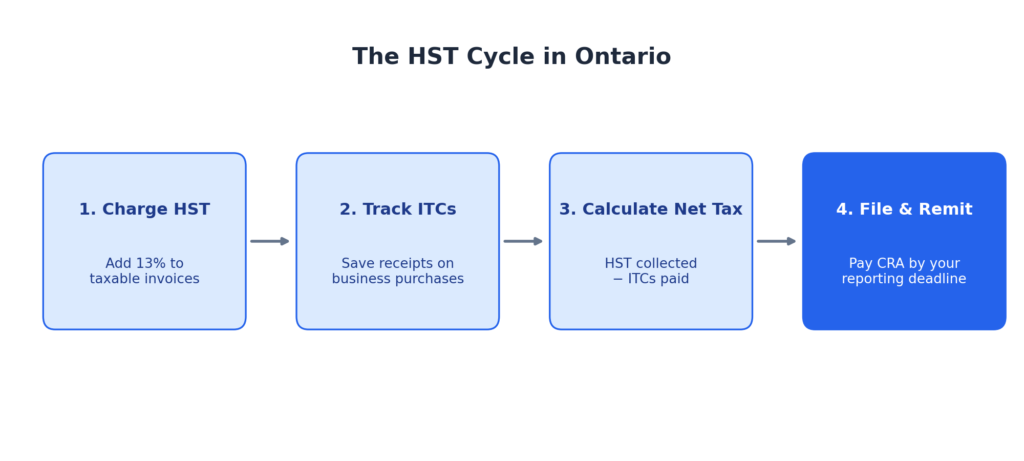
Here’s the Harmonised Sales Tax charging, remittance, and ITC details you must know:
- Charging HST: Invoices, Receipts and What to Show Customers
When you charge Harmonised Sales Tax:
- Show the HST amount separately on invoices and receipts (price before HST, HST amount, total).
- If you are registered but choose to include HST in your displayed prices, the invoices should still break out the tax so business clients can claim ITCs.
For sales outside Ontario, different rules or rates may apply (GST only or another province’s HST). You should use CRA’s tax calculator or guidance to confirm which rate applies by location of supply.
- Input Tax Credits (ITCs): Recovering the Tax You Paid
One of the big benefits of registration is ITCs. You can recover the GST/HST you paid for supplies used in your commercial activities (rent, utilities, equipment, professional fees, etc.). Claim ITCs as follows:
- Register.
- Have original, valid receipts/invoices that show the GST/HST paid.
- Use the purchases in your commercial activities.
Note: If you use the Quick Method (see below), you generally cannot claim ITCs for most operating expenses because the remittance rates already account for them. However, you can still claim ITCs for certain capital purchases. So, you should keep records for at least six years in case of CRA review.
- Calculating & Remitting HST (Regular Method)
Under the regular method:
- Sum up the HST you collected from customers during the reporting period.
- Add up ITCs (HST you paid on business expenses).
- Net tax = HST collected − ITCs. If positive, remit that amount to CRA. If negative, you may receive a refund or a credit.
- File the GST/HST return for your reporting period and pay the net amount by your deadline (monthly/quarterly filers: one month after period end; annual filers: three months after fiscal year-end for filing and payment deadlines may differ for certain small suppliers).
CRA has specific deadline rules for each reporting frequency.
- The Quick Method (Simplify Bookkeeping)
The Quick Method of accounting is an election small businesses can make to simplify Harmonised Sales Tax remittance. Instead of tracking ITCs, you charge Harmonised Sales Tax at the applicable rate but remit a fixed remittance percentage of your taxable (tax-included) sales. The remittance rates change for every province and business type. For many Ontario service businesses, the remittance rate is commonly referenced at around 8.8%. However, you must consult CRA’s tables for your exact category and period.
The Quick Method can save admin time and, in some cases, reduce net tax payable. It is especially for businesses with low taxable purchases. It prevents you from claiming ITCs on most operating expenses (you still can for certain capital items).
Before electing the Quick Method:
- Confirm you are eligible (typically, worldwide taxable supplies ≤ $400,000 in recent quarters).
- Model both methods on your expected purchases to see which is cheaper.
Remember, an election remains in effect until you revoke it or no longer meet eligibility.
If you’re also reporting self-employment income, you may need to complete a T2125 form. Learn exactly how to fill it out here.
FAQs
What does HST management actually involve?
Beyond just registering, it means charging the correct 13% on every taxable sale, keeping receipts to claim Input Tax Credits, calculating your net tax each period, and filing/remitting on time — even when you owe nothing.
How do I pay HST in Ontario?
You remit through the CRA’s My Business Account or Business Registration Online portal, on a monthly, quarterly, or annual schedule based on your assigned reporting period.
Do I need to charge HST on every sale in Ontario?
Most taxable goods and services, yes. Some supplies — residential rent, most medical and financial services — are exempt and don’t require HST.
Conclusion
Getting Harmonised Sales Tax right protects your business, streamlines customer interactions, and keeps cash flow stable. A few good systems that make your invoicing reliable, keep the clean records, and use the right reporting method are a must. Most Ontario businesses can treat Harmonised Sales Tax as a routine and manageable part of daily operations rather than a recurring headache this way.